Wednesday, August 15, 2012

Smart fingertips - Seminar topic

Abstract

We describe the use of semiconductor nanomaterials, advanced fabrication methods and unusual device designs for a class of electronics capable of integration onto the inner and outer surfaces of thin, elastomeric sheets in closed-tube geometries, specially formed for mounting on the fingertips. Multifunctional systems of this type allow electrotactile stimulation with electrode arrays multiplexed using silicon nanomembrane (Si NM) diodes, high-sensitivity strain monitoring with Si NM gauges, and tactile sensing with elastomeric capacitors. Analytical calculations and finite element modeling of the mechanics quantitatively capture
the key behaviors during fabrication/assembly, mounting and use. The results provide design guidelines that highlight the importance of the NM geometry in achieving the required mechanical properties. This type of technology could be used in applications ranging from human–machine interfaces to ‘instrumented’ surgical gloves and many others.

Electronic Finger Electronic fingertips could give robots a sense of touch, or allow doctors to operate via virtual touch. John Rogers/University of Illinois

http://rogers.matse.illinois.edu/files/2012/nanotechfingertip.pdf

Imagine feeling like you’re lifting a 50-kilogram weight just by pulling at thin air. That’s just one of the possible applications of new "smart fingertips" created by a team of nanoengineers. The electronic fingers mold to the shape of the hand, and so far the researchers have shown that they can transmit electric signals to the skin. The team hopes to one day incorporate the devices into a smart glove that creates virtual sensations, fooling the brain into feeling everything from texture to temperature.

Scientists have already developed circuits that stimulate our sense of touch. Some are used in Braille readers that allow blind people to browse the Internet. The devices work by sending electric currents to receptors in the skin, which interpret them as real sensations. However, most of these circuits are built on flat, rigid surfaces that can’t bend, stretch, or fold, says Darren Lipomi, a nanoengineer at the University of California, San Diego, who was not involved in the new study.

Hoping to create circuits with the flexibility of skin, materials scientist John Rogers of the University of Illinois, Urbana-Champaign, and colleagues cut up nanometer-sized strips of silicon; implanted thin, wavy strips of gold to conduct electricity; and mounted the entire circuit in a stretchable, spider web-type mesh of polymer as a support. They then embedded the circuit-polyimide structure onto a hollow tube of silicone that had been fashioned in the shape of a finger. Just like turning a sock inside out, the researchers flipped the structure so that the circuit, which was once on the outside of the tube, was on the inside where it could touch a finger placed against it.

To test the electronic fingers, the researchers put them on and pressed flat objects, such as the top of their desks. The pressure created electric currents that were transferred to the skin, which the researchers felt as mild tingling. That’s a first step in creating electrical signals that could be sent to the fingers, which could virtually recreate sensations such as heat, pressure, and texture, the team reports online today inNanotechnology.

The work is "a striking achievement," Lipomi says, who notes that the device could have lots of applications. "In a virtual world, a trainee could perform virtual surgery, in which the devices were used to trick the trainee’s brain into believing they were actually performing a delicate task."

Rogers says another application of the technology is to custom fit the "electronic skin" around entire organs, allowing doctors to remotely monitor changes in temperature and blood flow. Electronic skin could also restore sensation to people who have lost their natural skin, he says, such as burn victims or amputees.


Monday, August 13, 2012

Plastic Memory

ABSTRACT
 A series of advances in organic memory technology is demonstrated that enable an entirely new low-cost memory technology. Researchers incorporate these advances with the one of the most flexible material PLASTIC. This novel memory technology can be utilized in a three-dimensional onetime- programmable storage array. Without the prohibitive costs of silicon processing, this memory is capable of setting cost points several orders of magnitude lower than their inorganic counterparts. They have also successfully integrated this technology onto flexible plastic substrates. Combined with stacking, these vertical memory elements can create ROM densities denser than many inorganic memories, at a fraction of the cost.

Refer 
Plastic-Memory Report
plastic memory report  

Plastic Memory PPT


A conducting plastic has been used to create a new memory technology with the potential to store a megabit of data in a millimeter-square device - 10 times denser than current magnetic memories. The device should also be cheap and fast, but cannot be rewritten, so would only be suitable for permanent storage.
Imagine a scenario where the memory stored in your digital camera or personal digital assistant is partially based one of the most flexible materials made by man: plastic.
Scientists at HP Labs and Princeton University are excited a new memory technology that could store more data and cost less than traditional silicon-based chips for mobile devices such as handheld computers, cell phones and MP3 players.
But this chip is different than silicon technologies such as the popular flash memory, the researchers said, because it's partially made of plastic in addition to a foil substrate and some silicon. And while flash memory can be rewritten, the new technology can be written to only once. But it can be read several times and retains data without power because it won't require a laser or motor to read or write.
HP scientist Warren Jackson said simplifying the production of such memory chips is a key factor because it has the potential to lower the cost of memory use on a per megabyte basis for customers. However, this technology could potentially store more data than flash, and perhaps even become fast enough to store video, he said.
"This has the ability to work for a slightly different market than flash because we would now have the ability to not be able to write it a bunch of applications, but just read it so it becomes a permanent record.," Jackson told internetnews.com.

Moreover, this could be favorable to companies concerned about compliance regulations such as HIPAA and Sarbanes-Oxley, ensuring that the integrity of data on documents is preserved over long periods of time, the scientists said.
According to research analysts, finding alternative sources of memory has become a popular research issue because flash memory is expected to reach serious limitations as the dimension demands on devices increasingly get smaller to host a variety of form factors. Smaller memory space means the transistors leak more electricity and suck up more power.
But Gartner research analyst Richard Gordon said engineering obstacles facing memory technologies stretch back 30-plus years and noted that just last week Intel announced a new transistor to take care of the leakage problem.
"Flash technology is currently at a process node of the .11 micron level," Gordon said "There is a roadmap to accommodate it for the next 10 years so it still has a long time to go before it runs out of steam. I don't see that changing unless there is a technology in terms of cost-per-bit and performance that blows flash out of the water."

Friday, August 10, 2012

HDMI (High-Definition Multimedia Interface)


HDMI (High-Definition Multimedia Interface)

Abstratct


HDMI (High Definition Multimedia Interface) is a specification that combines video and audio into a single digital interface for use with digital versatile disc (DVD) players, digital television (DTV) players, set-top boxes, and other audiovisual devices. The basis for HDMI is High Bandwidth Digital Content Protection (HDCP) and the core technology of Digital Visual Interface (DVI). HDCP is an Intel specification used to protect digital content transmitted and received by DVI-compliant displays.

HDMI® (High-Definition Multimedia Interface) is an interface standard used for audiovisual equipment such as high-definition television and home theater systems. With 19 wires wrapped in a single cable that resembles a USB wire, HDMI® is able to carry a bandwidth of 5 Gbps (gigabits per second). This is more than twice the bandwidth needed to transmit multi-channel audio and video, future-proofing HDMI® for some time to come. This and several other factors make HDMI® much more desirable than its predecessors, component video, S-Video and composite video.

HDMI® is an uncompressed, all-digital signal, while the aforementioned interfaces are all analog. With an analog interface, a clean digital source is translated into less precise analog, sent to the television, then converted back to a digital signal to display on screen. At each translation, the digital signal loses integrity, resulting in some distortion of picture quality. HDMI® preserves the source signal, eliminating analog conversion to deliver the sharpest, richest picture possible.

Previous video interfaces required separate audio cables, with the vast majority of people using standard RCA L/R analog audio jacks. HDMI®, with its abundant bandwidth and speed, carries not only video but also up to eight digital audio channels for uncompromised surround-sound. It replaces the tangle of wires behind the system with a single cable, greatly simplifying the entire setup process of the home theater system while delivering top tier performance.

Connect a PC to a HDTV

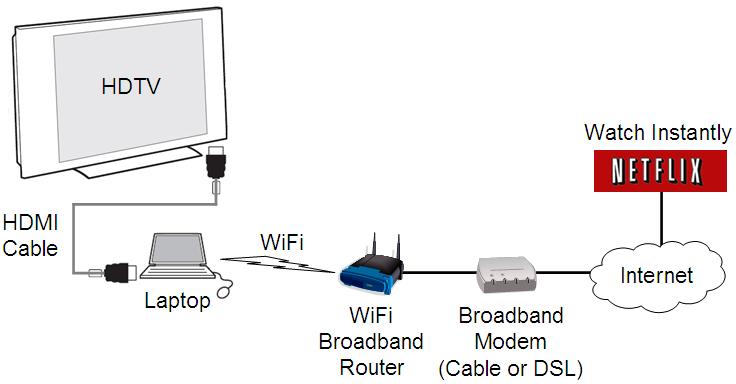
Here’s the computer to HDTV connection diagram to watch Netflix, YouTube, Hulu or any streaming Internet video on the TV. If you’re like me, you already have a:
Netflix subscription
broadband connection
WiFi router
computer with a HDMI port
HDTV

The the only thing I needed buy was a 6-foot HDMI cable.

Computer to HDTV Connection Diagram

hdmi final ppt

Advantages and Dis-advantages of HDMI – High Definition Multimedia Interface

This article gives a short introduction to HDMI, types of HDMI cables, advantages and dis-advantages of HDMI standard for carrying and displaying audio/video signals over their analog counterparts.
 
What is HDMI?
Do you remember the cables that you use to connect your DVD player with the TV? You could have used Composite audio/video cables or S-Video cables or Component video cables for HDTV. They all carry signals in the analog format (In component video, the signals are converted from digital to analog for transmission and reconverted to digital at the receiving end).
HDMI is the All-Digital interface where the signals are carried in digital format and hence there is no conversion required at either end. HDMI stands for High Definition Multimedia Interface. It is an all digital audio-video interface which carries signals in uncompressed format. It has been accepted by the consumer/ institutional electronics industry.
HDMI cables consist of 19 separate wires which carry high speed video, audio and other digital information. The digital audio and video data is encoded in to three colour channels and a clock channel.

Types of HDMI Cables:
Standard cables: They are also known as Category 1 HDMI cables. They perform at pixel speeds of 75 Mhz supporting bandwidth of about 2.23 Gbps. This is fine for carrying an uncompressed 1080i signal.
High Speed cables: They are also known as Category 2 HDMI cables. They perform at pixel speeds of 340 MHz supporting bandwidth of about 10.2 Gbps. They can handle the latest 1440p and WQXGA resolutions.

Advantages of HDMI:
¤ Higher Quality: HDMI enables loss-less transmission and better quality video at low brightness scenes at higher resolutions. So, the video quality is much better than their analog counterparts as there is no conversion involved either. High contrast details like text etc. are displayed more sharper.

¤ Intelligence: Two way communications between video sources are enabled by HDMI Interface, which enables automatic configuration (between 480p or 720p, 16:9 or 4:3 for example). So, external intervention to identify the best resolutions and audio formats is minimized. This is accomplished by using a standard known as EDID – Extended Display Identification Data.

¤ Authentication and Encryption: HDMI standard supports authentication to ensure that the devices are authorized to receive the content sent by the HDMI enabled sources. They also enable authentication to make sure that people cannot tap in to the cables to copy or pirate content sent through them.

¤ Signal Integrity: They enable digital signals to be stored, transmitted and viewed without changes from the original (unlike other media which require analog to digital conversion) and hence the signal degradation is not prominent. So, it is better to transmit HD content.

¤ Single Cable: This is truly a single cable solution as there is only a single cable that carries audio, video and control information. So, the complexity of implementing an audio video control system is lesser.

¤ Deep Colours: HDMI supports 10 bit, 12 bit and 16 bit (RGB or YCbCr) colour depths which can render over one billion colours in good detail.

¤ No Compression: Since HD signals are not compressed while transmission, there is no de-gradation in signal quality.

¤ Compatibility with DVI: Since it is backward compatible with DVI interface, DVI enabled PC’s can send HD content to display devices.

¤ Supports multiple audio and video formats: Multiple audio and video formats like standard stereo, multi channel surround sound, 720p, 1080i, 1080p, NTSC, PAL etc. are supported by HDMI standard.

¤ Hot Plug Detect: The sink device (display unit) can indicate its presence to a source with a hot plug detect signal to identify when a cable has been connected and to start authentication.

¤ CEC: Consumer Electronics Control is a communication link that enables devices connected via HDMI to talk to each other. For example, multiple DVD players from a single manufacturer can communicate with each other so that only one plays at a time. Some video sources can also send a power-off signal to turn off certain displays connected to it.

¤ Display port compatibility: Display port is a parallel technology for audio/video interface like HDMI and HDMI devices are compatible with Display Port interfaces.

¤ Dolby/DTS: HDMI supports Dolby/DTS-8 channel audio streams for highest quality.

Dis-advantages of HDMI:
¤ Distance Limitations: Maximum distance for HDMI Cat1 cables is up to 35 meters (approx) for full capacity and maximum distance for HDMI Cat2 cables is up to 10 meters (approx) for full capacity. Beyond this limit, they need extenders. There are extenders like UTP cable extenders for HDMI, HDMI cable extenders, Fiber extenders for HDMI and Coaxial extenders for HDMI. Even Switches, Distribution amplifiers, audio/video processors act as repeaters. But extending HDMI cables this way has its limitations.

¤ Switching Delays: Sometimes, blank screens can be caused due to authentication delays. There can also be screen flashing errors.

¤ Field Termination: There are limitations to field terminations of HDMI cables. They cannot be easily terminated in the field like their analog counterparts.

¤ Costly: HDMI cables are more expensive (per meter) than their analog counterparts.

¤ Multiple locations: They are difficult to run in multiple applications spanning various locations. There are more complexities in such situations than just the distance limitations.

¤ EDID: One such complexity is with EDID (Extended Display Identification Data) which is used in automatic identification of resolutions and audio formats. Both HDMI and EDID specifications offer limited guidance in multiple location deployment scenarios.

¤ CEC: The Consumer Electronic Format which enables the different devices to talk to each other becomes a problem when there is a central control system to control all the connected audio/video devices. It causes confusion when the devices themselves change their configuration as they might get undetected by the control systems.

¤ Multi-Channel Audio: While HDMI sources can transmit multi-channel audio sources, they cannot transmit multi-channel and standard two channel stereo signals at the same time (simultaneously). This becomes a problem with multi-room installations that has various devices supporting different audio formats.

¤ DVI Compatibility: HDMI devices are compatible with DVI interfaces but require a separate audio cable as DVI carries only video signals. It also needs a HDMI-DVI connector in such scenarios.
excITingIP.com


Thursday, August 9, 2012

Ethical Hacking

 Abstract

Today more and more softwares are developing and people are getting more and more options in their present softwares. But many are not aware that they are being hacked without their knowledge. One reaction to this state of affairs is a behavior termed Ethical Hacking” which attempts to proactively increase security protection by identifying and patching known security vulnerabilities on systems owned by other parties.
A good ethical hacker should know the methodology chosen by the hacker like reconnaissance, host or target scanning, gaining access, maintaining access and clearing tracks. For ethical hacking we should know about the various tools and methods that can be used by a black hat hacker apart from the methodology used by him. From the point of view of the user one should know atleast some of these because some hackers make use of those who are not aware of the various hacking methods to hack into a system. Also when thinking from the point of view of the developer, he also should be aware of these since he should be able to close holes in his software even with the usage of the various tools. With the advent of new tools the hackers may make new tactics. But atleast the software will be resistant to some of the tools

what is ethical hacking

An ethical hacker is a computer and network expert who attacks a security system on behalf of its owners, seeking vulnerabilities that a malicious hacker could exploit. To test a security system, ethical hackers use the same methods as their less principled counterparts, but report problems instead of taking advantage of them. Ethical hacking is also known as penetration testing, intrusion testing and red teaming. An ethical hacker is sometimes called a white hat, a term that comes from old Western movies, where the "good guy" wore a white hat and the "bad guy" wore a black hat.

One of the first examples of ethical hackers at work was in the 1970s, when the United States government used groups of experts called red teams to hack its own computer systems. According to Ed Skoudis, Vice President of Security Strategy for Predictive Systems' Global Integrity consulting practice, ethical hacking has continued to grow in an otherwise lackluster IT industry, and is becoming increasingly common outside the government and technology sectors where it began. Many large companies, such as IBM, maintain employee teams of ethical hackers.

Ethical Hacking PDF 1

Ethical Hacking PDF 2

Ethical Hacking PPT 1


Ethical Issues of Computer Hacking


Ethical Issues of Computer Hacking thumbnail
Computer hackers learn to circumvent security measures, such as passwords.
Many discussions about the ethical ramifications of computer hacking have occurred since the issue gained prominence. Some see the ethical issues involved as cut and dry, some consider ethical breaches only when laws have been broken and others consider certain types of hacking ethically sound and some types as ethically questionable. The first layer of this debate usually focuses on the definition of computer hacking and the motivation of the hackers.


Definitions of Hacking

  • Hacking occurs when someone intentionally accesses a computer without authorization. The term is often used to refer to a person with detailed computer knowledge who commits the act to accomplish criminal acts. The act often damages property, spreads viruses and causes financial loss. The New Hacker`s Dictionary uses several definitions including someone who "enjoys exploring the details of programmable systems and how to stretch their capabilities," "programs enthusiastically (even obsessively)," and "enjoys the intellectual challenge of creatively overcoming or circumventing limitations."

Ethical Considerations by Motive

  • The New Hacker Dictionary and Marcia J. Wilson of Computerworld both define hackers while distinguishing them from hackers with intent to harm. Such a "cracker" is, according to the Hacker Dictionary, "a malicious meddler who tries to discover sensitive information by poking around." Wilson contrasts crackers with three other motivations she believes are ethically justified. "Hacktivists" infiltrate systems for political purposes; hobbyist hackers do so to learn and share with those in the hacking community; and research and security hackers are "those concerned with discovering security vulnerabilities and writing the code fixes." Wilson and others believe ethical issues arise in hacking when the goals are outside of these three categories. She considers political activism through computer hacking equitable to peaceful protests in the streets and points to the First and Fourth Amendments as justification.

Ethical Issues by Legality

  • One way that people can interpret actions for unethical behavior is considering the legality. The United States Credit Fraud and Abuse Act prohibits intentionally accessing another`s computer system when it threatens the financial well-being of an individual or business to reveal state secrets, upset international communications, defraud, cause damage or aid extortion. States have their own laws as well.

Other Ethical Considerations

  • Other points considered in discussions of ethical hacking include the costs associated with security checks even when no alterations or damages have occurred. Many consider the high amount of adolescent participants and factor this into ethical judgments, believing the anonymity associated with hacking makes crimes more likely to happen than they would outside of cyberspace.


Read more: Ethical Issues of Computer Hacking | eHow.com http://www.ehow.com/info_8482153_ethical-issues-computer-hacking.html#ixzz2BLFphvcI


Types of Ethical Hackers


Types of Ethical Hackers thumbnail
Hackers access computers and networks without authorization.
Hacker movies like "Swordfish" can give people the idea that hackers may not be all that bad. In actuality, hackers often pose a serious security threat. A Florida company named Acxiom had to spend $7 million to repair its database after an attack by one hacker. Luckily, there are hackers out their whose intent is not to caues harm. While the word "ethical" can depend on perception, the following are hackers you may not be too afraid of.


Hacktivists

  • Hacktivism is hacking into a computer system illegally for a social or politically motivated reason. These hackers could just leave a large message on the main page of a website, or even disrupt traffic to a site altogether. Some people see this as a form of protest, and therefore as protected speech. The question is whether anybody in America would object if someone hacked into a website where pedophiles congregate and left a message saying that phedophilia is wrong. Therein lies the moral debate on whether hacktivists are ethical or not.  Read More

Cyberwarrior

  • This is another gray area of ethical hacking. Whether or not this type of hacking is ethical is all in the eye of the beholder. Cyberwarriors are computer experts and hackers who participate in cyberwarfare, which are actions undertaken or sanctioned by a nation-state to infiltrate another country's networks or computers to cause disruption or damage.

    Black Box Penetration Testers

    • This is a hacker who is hired by a person or company to actually infiltrate a computer network or system. The hacker will act as a malicious hacker, trying to find vulnerabilities in a system or network that would allow him to attack it. The black box penetration tester has no prior knowledge of the network or system he is trying to infiltrate. By finding vulnerabilities, he can advise the company of individual about what is needed to strenghten a website from future hacking.

    White Box Penetration Testers

    • This is another type of hacker that is hired by a person or company to break into a computer network or system. The white box hacker is much like the black box hacker in that they both are legally breaking into these systems in an effort to help the person or company who hires them. The only difference between the two is that white box penetrators are given complete knowledge of the system or network they are infiltrating. The hacker simulates an attack from an insider of the organization.

    Certified Ethical Hacker/Licensed Penetration Tester

    • These hackers perform the duties of black box and white box penetration testers. They look for vulnerabilities and weaknesses in systems and networks. These two certifications are given by the International Council of E-Commerce Consultants. All of these ethical hackers must be re-certified every three years.

    References:

    Read more: Types of Ethical Hackers | eHow.com http://www.ehow.com/info_8279840_types-ethical-hackers.html#ixzz2BLDRtcSX


    The Advantages of Ethical Hacking


    The Advantages of Ethical Hacking thumbnail
    Ethical hacking helps alert a company to system vulnerabilities.
    The term "hacking" has negative connotations and is associated with outsiders breaking into somebody else's computer network. Hackers could aim to steal information, or their activities could disable a company's systems. However, another practice is "ethical hacking" whereby an organization pays hackers -- the good kind -- to protect its computer system from attack by learning how to attack it themselves. This practice enables an organization to learn how nefarious hackers can exploit vulnerabilities in its computer systems.


    Techniques


    • One type of ethical hacking involves testing an organization's networks, both internal and external, to identify any weaknesses that outsiders could tap. Ethical hackers could also test applications to find any flaws and go through an organization's source codes. Other techniques include testing for the possibility of attacks from someone with access to the wireless network, and checking for unauthorized modems.

    Advantage

    • One major advantage of ethical hacking is that it helps an organization better protect its systems and information. It is a way of augmenting the efforts of an organization's information technology professionals. The adoption of ethical hacking techniques must be a part of an organization's overall security efforts. However, the realities of tight budgeting mean that this additional layer of security is not always a priority for many organizations.


    Read more: The Advantages of Ethical Hacking | eHow.com http://www.ehow.com/info_8431442_advantages-ethical-hacking.html#ixzz2BLGTve9n


    Protection Against Theft

    • If a hacker gets into an organization's systems, then the hacker could gain access to valuable information. The organization's intellectual property and sensitive client information are at risk. Hackers have been known to steal such information. If organizations want to protect against theft, they could schedule routine ethical hacking exercises to find out if any flaws exist in their systems. This makes them less vulnerable to outside hackers.

    Protection from Lawsuits

    • The United States is a litigious society. If hackers get into a company's systems and steal customer information, then the company could face potential lawsuits. Consumers could file lawsuits against an organization for failing to safeguard their personal information. Ethical hacking could help prevent the possibility of such lawsuits. Organizations may also have to meet certain legislative and regulatory requirements relating to safety of consumer information. Ethical hacking helps them meet such mandates.


    Read more: The Advantages of Ethical Hacking | eHow.com http://www.ehow.com/info_8431442_advantages-ethical-hacking.html#ixzz2BLGa57Nv


    Seminar Report


Saturday, August 4, 2012

Money Pad, The Future Wallet

 Abstract
Money in the 21st century will surely prove to be as different from the money of the current century as our money is from that of the previous century. Just as fiat money replaced specie- backed paper currencies, electronically initiated debits and credits will become the dominant payment modes, creating the potential for private money to compete with government-issued currencies." Just as everything is getting under the shadow of "e" today we have paper currency being replaced by electronic money or e-cash.
In the emerging field of electronic commerce, novel buzzwords like smartcards, online banking, digital cash, and electronic checks are being used to discuss money. But how are these brand-new forms of payment, secure? And most importantly, which of these emerging secure electronic money technologies will survive into the next century?
Here's a solution, which provides a form of security to these modes of currency exchange using the "Biometrics Technology". The Money Pad introduced here uses the biometrics technology for Finger Print recognition.
Every time the user wants to access the Money Pad he has to make an impression of his fingers which will be scanned and matched with the one in the hard disk of data base server. If the finger print matches with the user's he will be allowed to access and use the Pad otherwise the Money Pad is not accessible. Thus providing a form of security to the everlasting transaction currency of the future "e-cash".
Money Pad - A form of credit card or smart card similar to floppy disk, which is introduced to provide, secure e-cash transactions.

Refere:
Money-Pad The Future Wallet ppt1
Money pad,The Future-Wallet ppt2


Money Pad,The Future Wallet Report


MONEY PAD ppt