Sunday, March 30, 2014

Google Glass

Seminar On:- Google Glass

Abstract on Google Glass 

Google Glass is a wearable computer with an optical head-mounted display (OHMD) that is being
developed by Google in the Project Glass research and development project,with a mission of producing a mass-market ubiquitous computer.Google Glass displays information in a smartphone-like hands-free format, that can communicate with the Internet via natural language voice commands.

This study examines the role of Google Glass in relation to a possible contribution to network 
surveillance. Our privacy has become increasingly limited throughout the past decades due to the 
rapid rise of technology and social media. From the Fourth Amendment to George Orwell’s Nineteen 
Eighty-Four, society is full of warnings in regards to technology and surveillance’s collaboration. This 
paper will investigate the possible newest link in this collaboration, Google Glass, as well as provide 
a current status on network surveillance and the subsequent effects. To answer whether Glass is 
here to improve our everyday life or simply to improve Google’s database, selected theories are 
applied to analyze and interpret Glass’ possibilities and potentials in regards to network surveillance. 
Distrust towards Glass is determined and Google CEO Vice President’s arguments pave the way for 
discussion. His viewpoint is compared to the hypothetical scenario in Orwell’s Nineteen Eighty-Four, 
it is then discussed whether the possible outcome of Glass will move us closer to the ideas 
presented in Orwell’s dystopian novel. Through the use of before mentioned theories and analysis, it 
is concluded that Glass has a feasible viability to contribute to network surveillance

What is Google Glass

Google's project program for developing a line of hands-free, head-mounted intelligent devices that can be worn by users as "wearable computing" eyewear. The first product release from Project Glass, Google Glass, is expected to become available for purchase in 2013, and should retail for less than $1500.

Google Glasses will look like a pair of normal eyeglasses, but the lens of the glasses will be an interactive, smartphone-like display, with natural language voice command support as well as Bluetooth and Wi-Fi connectivity. Google Glass will be powered by the Android mobile operating system and is expected to offer compatibility with both Android-powered mobile devices and Apple iOS-powered devices.


How google glass works
How does Google Glass work?

If you still think smartphones and tablets are amazing devices that represent a ‘new’ era of personal technology, you’ll be amazed to learn they could already be well on their way to becoming obsolete, just as they had started making the PC obsolete. In a couple of years, your iPhone 5 or Samsung Galaxy S4 could be viewed with condescension by a new generation of users wearing smart glasses, which can do most things a smartphone can plus a whole lot more.
If this disruptive smart glasses revolution comes to pass, the most popular smart glasses will undoubtedly be Google Glass, because the world’s leading search engine and smartphone software company is already so far ahead in this game that it’s hard to see anyone catching it. Google has already put hundreds of prototype Google Glasses devices in the hands of testers around the world, and other bits and pieces that will make up the Google Glass ecosystem are already out there in some form. For instance, if you want to get a sense of how Google Glasses will work, try using Google Now on the latest Android devices – it’s a voice-controlled search engine that’s aware of your surroundings and tries to figure out what you need before you actually ask for it.
Powered by voice control – so no keyboards – Google Glass overlay the world you see around you with related information beamed onto your retina by a prism that receives from a tiny projector inside the lens. You see both the physical world and all relevant data associated with it, the kind of data that right now – in the relative stone age of PCs, tablets and smartphones – sits on a separate database somewhere, waiting for you to connect the dots.
With Google Glasses, the technology disappears from in front of you and you get data and applications in the context of what you’re doing or what you’re looking at. Want to know the weather right now? You won’t have to find the weather app and click on it to get a report. Weather apps for Google Glass will know when you’re looking up at the clouds and provide you with an instant weather report. If you’re unsure of what’s at a particular street address, look at the premises and Google Glass will tell you who’s inside, and possibly even show you the indoor plans along with a 360° panorama view if it’s a business.
If all Google Glass did was bring you an overlay of information, they would be amazing enough. However, they’ll do a lot more than that. In fact, they change the game completely. At this stage, Google is expected to formally release Google Glass either later this year or in early 2014.

Using Google Glass

Google Glass introduces an entirely new way of computing, with a simple, voice-driven user interface that strips away complexity and makes a number of tasks much more intuitive. Below are some examples of these.

01 Start tap

To start using Google Glass, you tap the frame of the glasses and you’re taken to the home screen. You don’t see a bunch of icons like on smartphone home screen, just a simple overlay box that carries any information and the ‘wallpaper’ is actually the real-life scene you’re looking at. To issue a command, you tap the frame again and say “OK Glassâ€.

02 Take a picture

After you issue the order “OK Glassâ€, you can instruct the glasses to do something specific by saying something like “take a pictureâ€. That’s it. There’s no fumbling around looking for the camera icon. We’re not sure at this point whether anything on the glasses frame lets the subject know they’re being photographed. Just be aware that if you’re chatting to someone wearing Google Glass, you’re right in their viewfinder.

03 Record video

Same goes with video. With Google Glass, you can record what you see without moving a finger. Already, several businesses in the US, ranging from strip clubs to casinos and even movie theatres, have announced that Google Glass will be banned from their premises. The porn industry is in a lather over the introduction of Google Glass, with many pornographers pointing to an inevitable increase in the popularity of POV (point of view) porn clips.

04 Share what you see

Now this is what we call serious sharing – actually sharing what you see with your friends (it’s not clear at this early stage whether Google Glass will be able to feed them a live video stream, but this is inevitable). The privacy ramifications of this kind of sharing are mind-boggling, but tech history tends to show that privacy concerns never ultimately get in the way of a cool new experience, such as when people agree to give the latest hot mobile app access to their location and address book data without much resistance.

05 Find your way

Lost? No problem, you have your very own super GPS navigating device to guide you along in the right direction. It’s perfect for the car, except that various road authorities have already said they’ll ban Google glasses in cars because of the possible other distractions the glasses can serve up while you’re driving.

06 Translate

Google Glass will able to read and translate any text you see, which makes them an absolute boon for travellers. For travellers, Google Glass will be a revolution, going a long way to removing language barriers and making travelling to far-flung places infinitely more convenient.

07 Your info butler

One of the key features of Google Glass is their awareness of where you are and what you’re looking at, at all times. It means they can anticipate your needs and flash up information that’s going to be relevant to you. This is what the Google Now search engine, available on the latest Android smartphones as well as on the iPhone, tries to do.

How it works

Google Glass contains the fundamental bits of any computer, including a CPU, sensors such as GPS, speakers, microphone and battery, to which are added a tiny projector and a prism that redirects the light onto your retina. Each component is neatly embedded in the frame. To keep the device as light as possible, most of the processing will actually take place in the cloud (like it does with Apple’s Siri), so a good mobile broadband signal is essential.
In this image below by artist Martin Missfeldt, you can see the projector and prism in the Google Glass working together. In essence, Google Glass is just a tiny projector embedded into a pair of glasses frames with some tiny computing components to drive the package.


Google Glass Seminar Document:


Thursday, August 29, 2013

e-wallet


Introduction

A Digital Wallet also known as e-wallet allows users to make electronic transactions quickly and securely. A Digital Wallet functions much like a physical wallet. The digital wallet is a method of storing various forms of electronic money (e-cash), the digital wallet has also evolved into a service that provides internet users with a convenient way to store and use online shopping information.


Abstract:


Using the basic concepts of Embedded Systems, an idea for changing the future of Cards (Banking, Petro, Health, Televoice, etc.) is proposed in this paper. Requirement of a special card reader, limited lifetime, acceptance being the main disadvantages of today's traditional cards, led to the design of e-Wallet. The main objective of e-Wallet is to make paperless money transaction easier.

 The main idea behind this paper is to bring in a cheaper, more versatile and much more easily usable kind of a card. Using this e-Wallet the transaction procedure can be as simple as: the customer goes to the point of sale (POS), does the purchasing and when it comes to the payment, the customer submits his e-Wallet to vender who connects it to his terminal (PC).

The vender displays the billing information to the customer who finalizes it. The amount in the e-Wallet is updated accordingly. Later at periodic intervals, the vender intimates the bank (in case of credit cards) which transfers the amount from the customer'(s) account to his. The advantages of e-Wallet are its ease of use (doesn't require a separate card reader), ease of maintenance, flexibility, safety, being the primary ones. 

The designing of the card is similar to any other embedded card. The designing cost of the card (e-Wallet) being as low as the price of a pizza. There are ample enhancements to this application from credit cards to televoice cards. Unlike traditional cards which are application oriented, all the applications' software can be embedded into this e-Wallet which provides multi-functionality.

What Is an eWallet?

Once you have been online for a few weeks or months, you will have an online identity. You may need and use quite a few online passwords and pins, along with personalized billing and shipping information. Not only do you need to enter your personal and financial data at each site, but you also have to remember and secure that information. An e-wallet is a convenient, secure place to store data related to your online identities. Once you start using one, you will wonder how you ever managed without it.


Misconceptions

Many popular browsers, including Internet Explorer and Firefox have some basic built-in e-wallet functions. However, storing your information in a browser is not as secure as using a separate program that is specifically designed for this task. In addition, if you change browsers, you may not have access to your data. Browsers also store your passwords in a separate location from your form data. In some cases, you need an add-on to store personal data that you need for completing forms. With few exceptions, these days, you will have a separate email program where you store email addresses for your contacts.

Function

E-wallets can store your passwords, credit card numbers, email contacts and vital data like your driver's license or social security numbers. You may have your personal data recorded in several disparate locations, including your browser, spreadsheets, a PDA and on paper. Not only is it inconvenient to manage your online experience this way, but it can also be risky. Paper can get lost or waterlogged. Trying to remember and update your email contacts and credit card information can be overwhelming. An e-wallet allows you to unify and store the information that you need. You will only need to remember one password to unlock your encrypted data.

Features

A consumer e-wallet is a standalone software application that you can download and install on your computer, PDA or Smartphone. Some of the most popular e-wallet software programs also allow you to store photos and maps. You can often customize the software's data entry options to fit your needs. Many retailers also provide credit card data e-wallets to their customers. These have limited features. They mainly store billing and shipping information.

Security

A good e-wallet uses strong encryption for stored data. The user also needs to enter a password to open the stored files. Some e-wallets employ additional password security features such as a limit on failed password attempts. Once this limit is reached, the user will be locked out.

Considerations

Syncing and backup options are important. Keeping a file separate gives you peace of mind and recovery options when you lose access to the original files, or the device stops working. The option to use your e-wallet on multiple electronic devices makes the software more useful. To simplify your life, you should choose ane-wallet that you can run from a USB flash drive, along with your Smartphone and a desktop or laptop.

How to use an e-wallet

The sites where e-wallet services are available generally have the following few easy steps to get started.

What are the benefits?

The sites where e-wallet services are available generally have the following few easy steps to get started.
Ease of use without having to enter your debit/credit card details for every online transaction.
For some sites there is no minimum amount and you can deposit an amount as low as Rs 10.
You can pass on the benefits of your e-wallet to your friends and family as well.
There is no chance of a decline of payment since e-wallet is a prepaid account.

What are the risks?

Revealed passwords can lead to theft.
There is no facility of refund; the amount is only redeemable against a purchase.

Where can you use E-Wallets?

Online Grocery Stores

Big Basket.com, a Bangalorebased online food and grocery store, offers an e-wallet facility for a simple payment option. The e-wallet on this site can be filled up with any sum of money, starting from as low as Rs 10. The maximum money that can be stored on Big Basket's e-wallet is Rs 10,000.

Utility Payments

Paying the electricity bill, phone bill, mobile bill and even booking a seat at the theatre can now be done with OxiCash. Your OxiCash e-wallet can be filled and recharged using net banking, debit cards and credit cards or even cash payments at OxiCash retail outlets.

Fly prepaid

If you are planning a vacation and fear spending the saved money elsewhere you can save up with, Lusso Trip's e-wallet facility. Customers generally keep a Rs 10,000 balance on their e-wallet and save up as much as Rs 1 lakh to book tickets when they want to.

E-wallet on mobile

Airtel Money transforms the mobile phone into a convenient wallet. The digitised money can be used on several shopping sites like ebay.in, Home Shop 18, Myntra and Book My Show. All one needs to have is an Airtel connection.

Buying Online

E-commerce major Flipkart was one among the first few to start am e-wallet service in 2011. Flipkart introduced e-wallet service to its customers, in addition to their cash-on-delivery option. Consumers can create an e-wallet and fill it up to Rs 10,000 at a time.

Recharging Mobile Phones

At Munkey.in, an e-wallet service, a mobile recharge can be done automatically on an auto disconnect missed call to their number. A customer can also go for scheduled recharge option where a filled e-wallet can recharge a number or DTH connection on set times of the month.

Read more:

 http://www.ehow.com/about_5133015_ewallet.html#ixzz2dNVc3iaY
http://articles.economictimes.indiatimes.com/2013-06-14/news/39976342_1_e-wallet-facility-airtel-money-flipkart
http://en.wikipedia.org/wiki/Digital_wallet

https://www.google.com/url?sa=t&rct=j&q=&esrc=s&source=web&cd=1&cad=rja&ved=0CDEQFjAA&url=http%3A%2F%2Finfo2myfriends.blog.com%2Ffiles%2F2010%2F11%2Fe-Wallet-%25E2%2580%2593-THE-FUTURE-OF-CARDS.doc&ei=838fUs-dComO7Aat74HgCQ&usg=AFQjCNF4iC756ysF8TY8lEFRlT90_8XcgQ&sig2=u6PE8Y_zztJsdqUmMDpLNA&bvm=bv.51495398,d.ZGU


Thursday, August 8, 2013

ZIGBEE | Seminar Topic


ZIGBEE ABSTRACT

ZigBee wireless mesh technology makes wireless sensor and control network applications practical. Cost-effective, simple-touse, capable of very long product functionality from a pair of standard alkaline cells, it is meant for developers who want either to get rid of the tether that their product must use or provide a new level of functionality to their products with wireless communications. The ZigBee Specification takes advantage of the IEEE STD 802.15.4 wireless protocol as the basic communications method, and expands on this with a robust mesh network, applications profiles and device descriptions as well as interoperability and compliance testing.

Refered From :http://www.techopedia.com/definition/4390/zigbee

Definition - What does ZigBee mean?

ZigBee is an open global standard for wireless technology designed to use low-power digital radio signals for personal area networks. ZigBee operates on the IEEE 802.15.4 specification and is used to create networks that require a low data transfer rate, energy efficiency and secure networking. It is employed in a number of applications such as building automation systems, heating and cooling control and in medical devices. ZigBee is designed to be simpler and less expensive than other personal are network technologies such as Bluetooth.

Techopedia explains ZigBee

ZigBee is a cost- and energy-efficient wireless network standard. It employs mesh network topology, allowing it provide high reliability and a reasonable range.One of ZigBee's defining features is the secure communications it is able to provide. This is accomplished through the use of 128-bit cryptographic keys. This system is based on symmetric keys, which means that both the recipient and originator of a transaction need to share the same key. These keys are either pre-installed, transported by a "trust center" designated within the network or established between the trust center and a device without being transported. Security in a personal area network is most crucial when ZigBee is used in corporate or manufacturing networks.

Why choose Zigbee?

• Reliable and self healing
• Supports large number of nodes
• Easy to deploy
• Very long battery life
• Secure
• Low cost
• Can be used globally


The 802 Wireless Space


Sensors & Controls:
Home Automation
Commercial/Industrial Automation
Remote Metering
Automotive Networks
Interactive Toys
Active RFID/ asset tracking
Medical


Zigbee specification

The ZigBee Alliance is an association of companies working together to enable reliable, cost-effective, low-power, wirelessly networked, monitoring and control products based on an open global standard.

Advantages of ZigBee over proprietary solutions?


  • Product interoperability
  • Vendor independence
  • Increased product innovation as a result of industry standardization
  • A common platform is more cost effective than creating a new proprietary solution from scratch every time
  • Companies can focus their energies on finding and serving customers


If you want to download the Zigbee specifiaction please follow the link below:

https://zigbeealliance.org/


Many in the industry are calling for a wireless networking standard that can deliver device-level communications for sensing, data acquisition, and control applications. Will the ZigBee standard make this a reality?


Jon Adams, The ZigBee Alliance


The new ZigBee protocol provides an open standard for low-power wireless networking of monitoring and control devices. Working with the IEEE 802.15.4 standard—which focuses on low-rate personal area networking and defines the lower protocol layers (i.e., the physical layer, or PHY, and the medium access control layer, or MAC)—ZigBee

Figure 1.


ZigBee uses the IEEE 802.15.4 physical and MAC (medium access control) layers to provide standards-based, reliable wireless data transfer. ZigBee adds network structure, routing, and security (e.g., key management and authentication) to complete the communications suite. On top of this robust wireless engine, ZigBee profiles provide target applications with the interoperability and intercompatibility required to allow similar products from different manufacturers to work seamle defines the upper layers of the protocol stack, from network to application, including application profiles. Think of 802.15.4 as the physical radio and ZigBee as the logical network and application software (see Figure 1). ZigBee uses the license-free ISM bands, which provide unrestricted geographic use.

The new standard targets home and building control, automation, security, consumer electronics, PC peripherals, medical monitoring, and toys. These applications require a technology that offers long battery life, reliability, automatic or semiautomatic installation, the ability to easily add or remove network nodes, signals that can pass through walls and ceilings, and low system cost.

ZigBee and the underlying 802.15.4 standard offer the system designer several classes of devices: the reduced-functionality device (RFD), the full-functional device (FFD), and the network coordinator. All ZigBee networks have at least one RFD or FFD and a network coordinator. Most sensor applications fall natively into the RFD class, with extended networks making use of both FFDs and network coordinators to form bridges and links required by the network topology. ZigBee networks can form autonomously, based on connectivity and function.
Data Reliability

Reliable data delivery is critical to ZigBee applications. The underlying 802.15.4 standard provides strong reliability through several mechanisms at multiple layers. For example, it uses 27 channels in three separate frequency bands (see Figure 2).

Figure 2.


 IEEE 802.15.4 provides three frequency bands for communications. Global utility, propagation, path loss, and data rate differences let ZigBee profile developers optimize system performance.


The 2.4 GHz band is used worldwide and has 16 channels and a maximum over-the-air data rate of 250 Kbps. Lower frequency bands are also specified. The 902–928 MHz band serves the Americas and much of the Pacific Rim, with 10 channels and a burst rate of 40 Kbps. European applications use one channel in the 868–870 MHz band, which provides 20 Kbps burst rate. This rich assortment of frequencies lets applications with the appropriate hardware configuration adjust in real time to local interference and/or propagation conditions.

Once on a specific channel, the 802.15.4 radio relies on a number of mechanisms to ensure reliable data transmission. First, the PHY layer uses binary phase shift keying (BPSK) in the 868/915 MHz bands and offset quadrature phase shift keying (O-QPSK) at 2.4 GHz. Both are robust and simple forms of modulation that work well in low SNR environments.

The information is coded onto the carrier with direct sequence spread spectrum (DSSS), an inherently robust method of improving multipath performance and receiver sensitivity through signal processing gain. The receiver sensitivity and selectivity is well suited for inexpensive silicon processes, with most vendors promising to meet or beat the standard. The size of the data payload ranges from 0 to 104 bytes, more than enough to meet most sensor needs. Figure 3 shows the construction of the data frame, also called a data packet.

Figure 3.

 The data packet is one of four packet structures provided in 802.15.4/ZigBee. In the MAC protocol data unit, the data payload is appended with source and destination addresses, a sequence number to allow the receiver to recognize that all packets transmitted have been received, frame control bytes that specify the network environment and other important parameters, and finally a frame check sequence that lets the receiver verify that the packet was received uncorrupted. This MAC frame is appended to a PHY synchronization and PHY header, which provides a robust mechanism for the receiver to quickly recognize and decode the received packet.


After receiving a data packet, the receiver performs a 16-bit cyclic redundancy check (CRC) to verify that the packet was not corrupted in transmission. With a good CRC, the receiver can automatically transmit an acknowledgement packet (depending on application and network needs), allowing the transmitting station to know that the data were received in an acceptable form. If the CRC indicates the packet was corrupt, the packet is dropped and no acknowledgement is transmitted. When a developer configures the network to expect acknowledgement, the transmitting station will retransmit the original packet a specified number of times to ensure successful packet delivery. If the path between the transmitter and receiver has become less reliable or a network failure has occurred, ZigBee provides the network with self-healing capabilities when alternate paths (if physically available) can be established autono-mously.

Battery Life

In many applications, you can’t afford to make regular trips back to a sensor to change the battery. Ideally, the sensor is good for the life of the battery.

The basic 802.15.4 node is fundamentally efficient in terms of battery performance. You can expect battery lifetimes from a few months to many years as a result of a host of system power-saving modes and battery-optimized network parameters, such as a selection of beacon intervals, guaranteed time slots, and enablement/disablement options.

Consider a typical security application, such as a magnetic reed switch door sensor. The sensor itself consumes almost no electricity; it’s the radio that uses the bulk of the power. The sensor is configured to have a “heartbeat” at 1 min. intervals and to immediately send a message when an event occurs. Assuming dozens of events per day, analysis shows that the sensor can still outlast an alkaline AAA battery. The configuration allows the network to update the sensor parameters remotely, change its reporting interval, or perform other remote functions and still have (theoretical) battery longevity well beyond the shelf life.

The network configuration plays an important part in the equation; most networks are expected to be stars or cluster trees rather than true meshes (see Figure 4), allowing the individual client devices to conserve battery energy.

Figure 4.
 Star networks are the most common, basic structure with broad utility. For larger physical environments, the cluster tree is a good way to aggregate multiple basic star networks into one larger network. Some applications will make best use of the mesh structure, which provides alternate route flexibility and the capability for the network to heal itself when intermediate nodes are removed or RF paths change.


Nodes that form the hubs or coordinator routes in the cluster tree can take advantage of beacon-based operation for synchronization across a widely dispersed network with only moderate impact on their own battery life.

Cost

System, individual node, service, and battery costs are all important. ZigBee and 802.15.4 maximize utility over this multidimensional space. There is sufficient flexibility in both standards to provide the sensor system developer with an assortment of tradeoffs to optimize cost with respect to system performance. For example, battery life can be optimized at the expense of service interval, and node cost and complexity can be traded for network complexity.

First-generation silicon is only now getting to the early adopters, and the system simplicity and the underlying flexibility of 802.15.4 promise that system developers will find ZigBee-based platforms more cost effective (at the same unit volumes) than Bluetooth or proprietary bidirectional wireless solutions. While platform hardware cost is always a critical part of the overall system cost, you must also consider the less tangible costs of system maintenance, flexibility, and battery life.

Transmission Range

ZigBee relies on the basic 802.15.4 standard to establish radio performance. As a short-range wireless standard, 802.15.4 doesn’t try to compete with high-powered transmitters but instead excels in the ultra-long battery life and low transmitter power. The standard specifies transmitter output power at a nominal –3 dBm (0.5 mW), with the upper limit controlled by the regulatory agencies of the region in which the sensor is used. At –3 dBm output, single-hop ranges of 10 to more than 100 m are reasonable, depending on the environment, antenna, and operating frequency band.

Instead of pure power, ZigBee augments the basic 802.15.4 simple transmitter and protocol with an extensible, sophisticated network function that allows multi-hop and flexible routing, providing communication ranges that can exceed the basic single-hop. Indeed, depending on the data latency re-quirements, you can practically create networks that use dozens of hops, with cumulative ranges inthe hundreds to thousands of meters. Networks can have star, cluster tree, or mesh structures; each comes with its own strengths.

Data Rate

It may not be obvious why a simple temperature or intrusion sensor needs to transmit data at 250 Kbps (at 2.4 GHz) or even 20 Kbps (at 868 MHz), but the reason becomes clear when you consider the need to prolong battery life. Even when the sensor is transmitting only a few bits or bytes, the system can be more efficient if it transmits and receives the data quickly. For instance, a 0.5 mW transmitter consumes many milliwatts whether it’s transmitting 100 or 100,000 bps. For any given quantity of data, transmitting at a higher data rate allows the system to shut down the transmitter and receiver more quickly, saving significant power.

Higher data rates at a given power level mean there’s less energy per transmitted bit, which generally implies reduced range. But both 802.15.4 and ZigBee value battery life more than raw range and provide mechanisms to improve range while always concentrating on battery life.
Data Latency

Sensor systems have a broad range of data-latency requirements. If sensor data are needed within tens of milliseconds, as op-posed to dozens of seconds, the requirement places different demands on the type and extent of the intervening network. For many sensor applications, data latency is less critical than battery life or data reliability.

For simple star networks (many clients, one network coordinator), ZigBee can provide latencies as low as ~16 ms in a beacon-centric network, using guaranteed time slots to prevent interference from other sensors. You can further reduce latencies to several milliseconds if you forego the beacon environment and are willing to risk potential interference from accidental data collision with other sensors on the network.

Data latency can also affect battery life. Generally, if you relax data-latency requirements, you can assume that the battery life of the client nodes will increase. This is even truer of network hubs, which are required to coordinate and supervise the network.

Consider a simple network that has de-manding latency requirements (e.g., a wireless computer keyboard and mouse). The user expects that a keyboard stroke or mouse movement will be reflected on screen in one or two screen-refresh intervals, generally between 16 and 32 ms. For this kind of star network, you can achieve data latency that beats this requirement.
Size

As silicon processes and radio technology progress, transceiver systems shrink in physical size. Forty years ago, a simple radio transceiver was the size of a shoebox and weighed 10 kg. Today, a similar transceiver might easily fit inside a thimble. In the case of ZigBee systems, the radio transceiver has become a single piece of silicon, with a few passive components and a relatively noncritical board design.

Microcontrollers that have native ability to interface with sensors (e.g., built-in digital I/O and A/D converters) have eclipsed even the radio’s rapid reduction in size. Today, the 8-bit MCU that hosts the application may already include dozens of kilobytes of flash memory, RAM, and various hardware-based timer functions, along with the ability to interface directly to the radio transceiver IC. The MCU requires only a few external passive components to be fully functional.

With the minimal overhead added by a ZigBee transceiver, the MCU can often continue to host the application along with the ZigBee protocol. Therefore, the silicon system size of a ZigBee solution (excluding sensors or batteries) is generally smaller than the batteries themselves. This compact form factor lends itself well to innovative uses of radio technology in sensor applications. Cer-tainly, with the advances in silicon-based sensors that have been coming to market over the past five years, it’s practical to design entire systems that take up <10%–20% of the volume of current-generation batteries. In-tegration is the key here, and even higher levels of integration are planned for future ZigBee and 802.15.4 platforms.

Data Security

It’s important to provide your sensor network with adequate security to prevent the data from being compromised, stolen, or tampered with. IEEE 802.15.4 provides authentication, encryption, and integrity services for wireless systems that allow systems developers to apply security levels as required. These include no security, access control lists, and 32-bit to 128-bit AES encryption with authentication. This security suite lets the developer pick and choose the security necessary for theapplication, providing a manageable tradeoff against data volume, battery life, and system processing power requirements. The IEEE 802.15.4 standard doesn’t provide a mechanism for moving security keys around a network; this is where ZigBee comes in.

The ZigBee security toolbox consists of key management features that let you safely manage a network remotely. For those systems where data security is not critical (e.g., a set of sensors monitoring microclimates in a forest), you may decide not to implement security features but instead optimize battery life and reduce system cost. For the developer of an industrial or military perimeter security sensor system, data security—and more importantly the ability to defend against sensor masking or spoofing—may have the higher priority. In many ZigBee-approved applications, security will already be a seamless part of the overall system.

Conclusion

ZigBee and the underlying 802.15.4 communications technology could form the basis of future wireless sensors, offering data reliability, long battery life, lower system costs, and good range through flexible networking. IEEE 802.15.4 is ready for release, and the ZigBee network, security, and profile specifications are scheduled to be released latter in the year. The first products are expected in the first half of 2004. ZigBee membership is open to all.

Friday, July 19, 2013

Password Pill


Password Pill -- Seminar Topic

Introduction:

Motorola Advanced Technology and Projects Group Chief Regina Dugan disclosed over the weekend at the D11 conference that the tech firm is working on electronic tattoo or implantable chips that would make the human body the tool for identification.

"Authentication is irritating. So irritating that only about half the people do it even though there's a lot of information about you on your smart phone," said Ms Dugan, who was a former Defense Advanced Research Projects Agency head.

Motorola is working with mc10, a relatively unknown tech firm, to develop the flexible tattoo technology or epidermal electronics which is made up of various sensors and gages to track multiple directions, electrical impulses in the skeletal structure or nerves, heart activity, temperature and light.

Why Password Pill?

The most annoying part of the internet is probably the fact that you have to memorize close to a dozen passwords to get to all your bank accounts and credit cards and social media profiles. And if you're lazy and just use one, then it's the worry that if one of those accounts gets hacked, it could easily be all of them.

Motorola thinks it has a solution to the password problem. At Wall Street's annual digital technology conference D11, Motorola announced their plans to create a pill that would serve as a password for all your accounts. What does that mean? You would provide Motorola with your password information and they would create a custom pill that had a tiny electronic chip inside it. That chip would basically turn your entire body into an authentication device, and you would theoretically never have to remember another password in your life. Naturally, the pill would pass through your body in about 24 hours, so you would have to take the pill on a daily basis.

“Electronics are boxy and rigid, and humans are curvy and soft,” Dugan said. So how can a password be more accessible by becoming more like a human body? Perhaps you attach it to the skin as a tattoo, or you swallow it as a pill. And this is less science fiction than reality, at least in Motorola’s lab and on the D11 stage, where Dugan showed off both products.

Working:

MC10 is a company that makes “stretchable circuits” that can be used for skullcaps to detect concussions in sports, or baby thermometers that constantly track an infant’s vitals. In the form of a temporary tattoo, the technology can attach an antenna and sensors directly on the body.

The key MC10 insight is “islands of silicon connected by accordion-like structures to stretch up to 200 percent and still perform,” Dugan said.
IMGS7774-X2
Dugan demos the password tattoo.
Dugan said Motorola is working with MC10 on a tattoo for authentication, and she showed a prototype on her own arm.

This was not some obscure research Motorola plucked out of the air. Earlier this year, MC10 completed an $18 million Series C round from investors including Medtronic and North Bridge Venture Partners.

Dugan is also working with a company called Proteus Digital Health that already has FDA clearance for an ingestible sensor as a medical device. She wants to use it for passwords, too.

“This pill has a small chip inside of it, with a switch. It also has what amounts to an inside-out potato battery,” she said. “When you swallow it, the acids in your stomach serve as the electrolyte, and they power it up and the switch goes on and off and it creates an 18-bit ECG-like signal in your body. Essentially, your entire body becomes your authentication token.”

Once swallowed, Dugan said, “it means that my arms are like wires, my hands are like alligator clips — when I touch my phone, my computer, my door, my car, I’m authenticated in. It’s my first super power. I want that.”
IMGS7779-X2
Walt Mossberg holds the password pill.
Proteus, by the way, is also pretty far along. It said last month that it had raised $62.5 million in Series F financing from investors including Oracle, Medtronic and Novartis.

Onstage, Dugan said that it would be medically safe to ingest 30 of these pills every day for the rest of your life, and that the only thing the pill exposes about its swallower is whether or not it has been taken.

“We have demoed this working and authenticating a phone,” added Dugan’s boss, Motorola head Dennis Woodside. “This isn’t stuff that’s going to ship anytime soon, but I think having the boldness to think differently about problems that everybody has everyday is really important for Motorola now.”

Reference:


Thursday, May 30, 2013

Wireless sensor network

Wireless sensor network

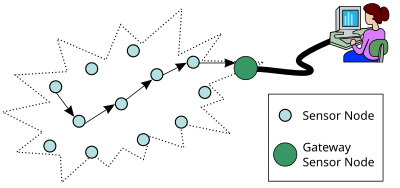
Wireless Sensor Networks (WSN) are an emerging and very interesting technology applied to different applications. They are formed by small, self organized devices that cooperate to form a large scale network with thousands of nodes covering a large area. The independent operation of the devices and the self-organization feature of the network present some challenges related to security, particularly regarding the security of the processed and routed data over the network.
As wireless sensor networks continue to grow, so does the need for effective security mechanisms. Because sensor networks may interact with sensitive data and/or operate in hostile unattended environments, it is imperative that these security concerns be addressed from the beginning of the system design. However, due to inherent resource and computing constraints, security in sensor networks poses different challenges than traditional network/computer security. There is currently enormous research potential in the field of wireless sensor network security. Thus, familiarity with the current research in this field will benefit researchers greatly. With this in mind, we survey the major topics in wireless sensor network security, and present the obstacles and the requirements in the sensor security, classify many of the current attacks, and finally list their corresponding defensive measures.